
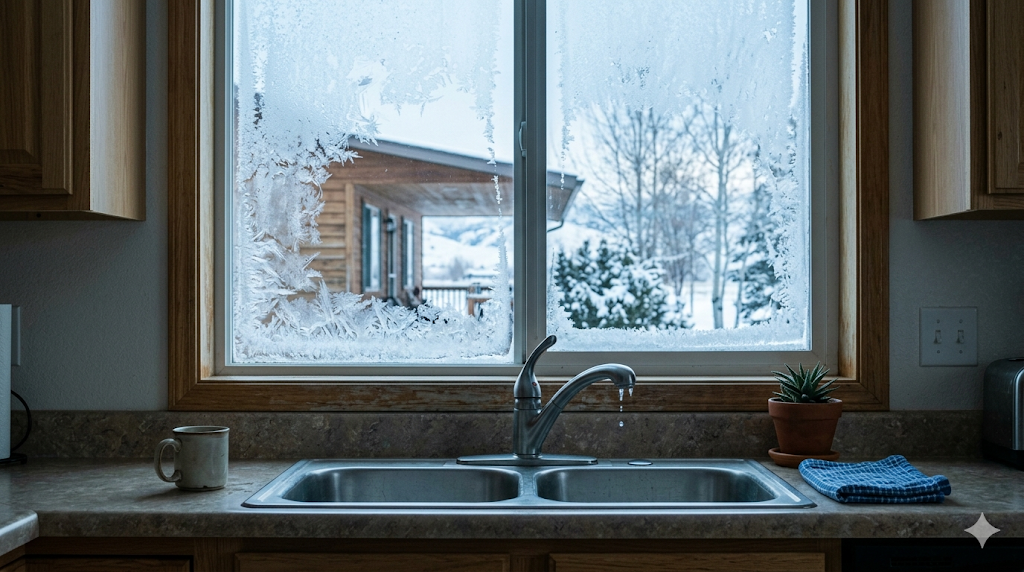
You turn on the kitchen faucet and nothing happens. The handle moves, the pipes are silent, and outside the thermometer reads minus 12 degrees. If you live in Southeast Idaho, that scenario plays out in hundreds of homes every winter, and how you respond in the next 30 minutes determines whether you spend the evening with a hair dryer or the next week with a flooded basement.
This guide walks you through how to thaw frozen pipes safely, what tools to use, what to never use, and how to know when the job has moved past DIY territory.
How to Tell If a Pipe Is Frozen
A pipe usually announces itself before water stops flowing entirely. Catching the early warning signs gives you a head start on thawing before pressure builds inside the line.
The most common indicators include:
- No water (or only a slow trickle) coming from one specific faucet
- Visible frost on the outside of an exposed pipe in a basement, crawl space, or under a sink
- A bulge or distortion in a section of pipe
- Strange smells coming from a drain (a frozen blockage can push odors back up the line)
- Knocking or banging sounds when you open a valve
If only one fixture has lost water and the rest of the house is fine, the freeze is almost certainly in the supply line feeding that fixture. If multiple fixtures on the same wall have stopped working, the freeze is probably in a shared section closer to the main. For more detail on what to watch for, our guide on the signs your pipes are frozen covers each indicator in depth.
Why You Need to Act Fast (Before the Pipe Bursts)
Water expands roughly 9 percent when it freezes. Inside a closed pipe, that expansion creates pressure that can exceed 2,000 pounds per square inch, far beyond what copper, PEX, or PVC can hold.
Here is the part most homeowners get wrong: the pipe usually does not burst at the freeze itself. The ice plug is solid and immobile, so the pressure travels downstream and ruptures the pipe at a weak point, often a soldered joint or fitting between the ice and a closed faucet. That means the damage may not appear until after the ice begins to melt and water starts flowing again.
This is why every minute matters. The longer ice sits in your line, the higher the chance of a burst pipe and the water damage that follows.
Step-by-Step Guide for How to Thaw Frozen Pipes Safely
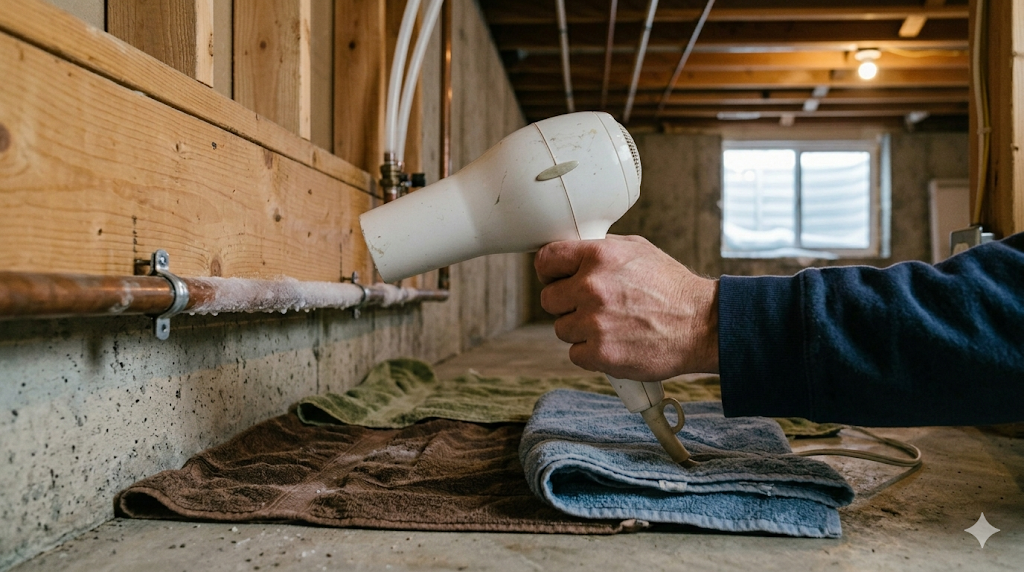
Once you have confirmed a freeze, follow these steps in order. Skipping the first step is the single most common mistake homeowners make.
1. Locate your main water shut-off valve. Find it before you start thawing. If the pipe has already cracked, water will rush out the moment the ice melts, and you need to be able to stop it in seconds. The shut-off is usually in the basement, crawl space, or near the water meter.
2. Open the affected faucet. Turn both the hot and cold handles to a slow trickle. This relieves pressure as the ice melts and gives the water somewhere to go. Without an open faucet, melting ice has nowhere to escape and the pressure stays trapped.
3. Identify the frozen section. Follow the supply line from the dead faucet back toward the main. Look for frost, a noticeably colder section, or visible bulging. Pipes in exterior walls, unheated basements, garages, and crawl spaces are the usual suspects.
4. Apply gentle, controlled heat. Always work from the faucet end toward the freeze, not the other way around. This lets melting water and steam escape through the open faucet rather than getting trapped behind more ice.
5. Monitor the flow. As the ice melts, water should begin trickling from the faucet. Keep heat on the pipe until full pressure returns, then check the area for leaks. A pipe that bursts during thawing will not always leak immediately, so inspect joints carefully once water is flowing again.
Safe Heat Sources to Use (and What to Never Use)
The golden rule of thawing is slow and steady. Aggressive heat does not melt ice faster, but it does crack pipes, scorch wood framing, and start house fires.
| Heat Source | Best For | Safety Notes |
|---|---|---|
| Hair dryer | Exposed pipes under sinks or behind appliances | Keep the dryer moving; avoid standing water |
| Heating pad | Wrapping around a frozen section | Set to medium; check every 15 minutes |
| Electric space heater | Cold basements and crawl spaces | Keep at least 3 feet from anything flammable |
| Warm towels and hot water | Visible pipes in tight spaces | Wrap the pipe in a towel, then pour warm water over the towel; never pour boiling water directly on the pipe |
| UL-listed heat tape | Long-term protection on at-risk pipes | Match the wattage to the pipe length and follow installation instructions exactly |
| Open flame, blowtorch, propane heater | Never use on any pipe | Causes fires, melts plastic pipes, and can rupture metal pipes through rapid expansion |
A few additional safety reminders apply across every method. Keep electrical devices away from any standing water. Never leave a heat source unattended. If you smell anything burning, stop immediately and let the area cool before continuing.
What to Do If You Cannot Find the Frozen Pipe
Pipes inside walls, ceilings, and tight crawl spaces are the hardest to thaw because you cannot apply heat directly. The freeze is real, but the ice itself is hidden behind drywall or insulation.
A few options are still available. Raise your thermostat by 5 to 10 degrees and leave the heat running. Open cabinet doors under sinks on exterior walls so warm air can reach the pipes inside. If the room with the suspected freeze has a closable door, leave it open so heat circulates freely.
If the freeze is in an interior wall, you can sometimes accelerate thawing by pointing a space heater at the wall from a safe distance, but this is slow and unreliable. Cutting into drywall to reach a pipe is a last resort. If the freeze does not clear within an hour or two of raising the heat, calling a professional is faster, cheaper, and safer than guessing.
When to Call a Plumber Instead of Continuing DIY
Some situations have moved past what a homeowner should handle alone. Call a plumber immediately if you notice any of the following:
- A visible bulge, crack, or split in the pipe
- Water staining on a ceiling or wall near the suspected freeze
- A sudden drop in water pressure when the ice begins to melt (a sign of a leak somewhere downstream)
- Pipes that have frozen repeatedly in the same spot, indicating a deeper insulation or routing problem
- Sub-zero temperatures forecast for the next several days, which can refreeze the pipe before you finish thawing
For homes in Idaho Falls, Rexburg, Rigby, Pocatello, and the surrounding communities, our team handles frozen and burst pipe repair year-round. If a pipe has already cracked, 24/7 emergency plumbing service can shut down the leak and start repairs before water damage spreads. If you have older galvanized lines that keep freezing in the same locations, full repiping is sometimes the most cost-effective long-term fix.
At What Temperature Do Pipes Freeze in Southeast Idaho?
The standard threshold is 20 degrees Fahrenheit. Once outdoor temperatures drop below that mark and stay there for six hours or more, exposed pipes are at real risk of freezing.
That number assumes a typical insulated wall and a pipe with at least some shelter. Pipes that run through unheated garages, exterior walls without insulation, or crawl spaces with poor air sealing can freeze at higher temperatures, sometimes as early as 32 degrees if wind chill is severe.
Southeast Idaho regularly sees overnight lows well below the 20 degree mark from December through February. Idaho Falls averages overnight winter lows in the teens, and stretches of minus 10 to minus 20 are not unusual during cold snaps. At those temperatures, an unprotected pipe can freeze in as little as three hours. The colder the air and the less insulation around the pipe, the faster ice forms.
How to Prevent This From Happening Again
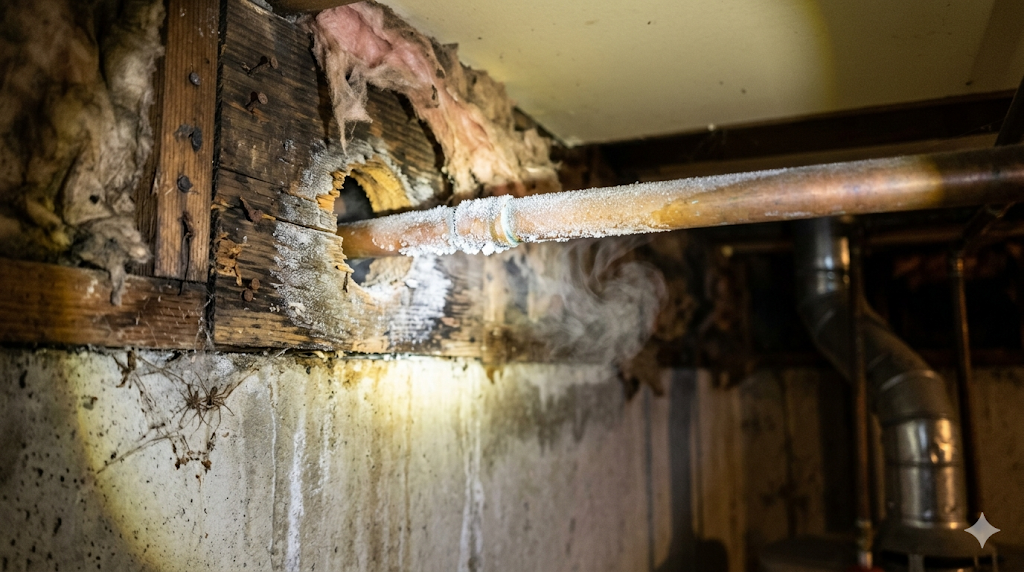
Thawing a pipe is a one-time fix; preventing the next freeze is the real win. A few simple habits will protect your plumbing through the rest of the season:
- Insulate exposed pipes in basements, crawl spaces, and garages with foam sleeves or pipe wrap
- Seal air gaps around pipes where they pass through exterior walls
- Disconnect garden hoses in the fall and shut off exterior spigots from inside
- Let cold-water faucets drip during sub-zero weather, especially on exterior walls
- Keep your thermostat at 55 degrees or higher even when the house is empty
- Know exactly where your main shut-off valve is located before you need it
For a deeper look at winter protection strategies, see our guide on how to prepare your pipes for frigid temperatures.
Frequently Asked Questions
At what temperature do pipes freeze?
Most pipes are at risk once outdoor temperatures drop below 20 degrees Fahrenheit and stay there for six hours or more. Pipes in uninsulated areas, exterior walls, or unheated spaces can freeze at higher temperatures, especially in heavy wind.
How long does it take for pipes to freeze?
Under typical conditions, a pipe needs about six to eight hours of sub-20 degree exposure to freeze. In severe cold, especially the minus 10 to minus 20 degree stretches Southeast Idaho sees during cold snaps, an exposed pipe can freeze in as little as three hours.
What is the fastest way to thaw a frozen pipe?
A hair dryer applied directly to the frozen section is usually the fastest safe method, taking 30 to 45 minutes for a typical exposed copper line. Always start at the faucet end and work toward the freeze, with the faucet open. Faster methods like blowtorches or propane heaters cause more problems than they solve and should never be used.
Can frozen pipes thaw on their own?
Yes, but waiting is risky. As ice melts, pressure trapped between the ice plug and a closed faucet can rupture the pipe. The slower and more passive the thaw, the higher the chance of a burst once water starts flowing again. Active, controlled thawing with the faucet open is much safer.
Will my pipes burst if they are already frozen?
Not always, but the risk is significant. Roughly one in five frozen pipe incidents results in a burst. The damage usually happens between the ice plug and a closed faucet, which is why opening the faucet before you start thawing is the most important single step.
Should I turn off my water if my pipes are frozen?
Locate the main shut-off valve before you start thawing, but leave the water on unless you see signs of damage. You need water flow to confirm the thaw worked. If the pipe bursts during thawing, you can shut off the supply within seconds.
Need Help With Frozen Pipes in Southeast Idaho?
If your pipes are frozen, cracked, or you suspect a leak after thawing, the team at Advanced Home Services is ready to help. Our licensed plumbers respond quickly to emergency calls across Southeast Idaho and carry the experience to handle everything from a single thaw to full plumbing repair and replacement. Call us today or schedule service through our contact page to get water flowing again.
About Advanced Home Services
Advanced Home Services has served Southeast Idaho homeowners for over 25 years, providing plumbing, HVAC, electrical, and water treatment services across Idaho Falls, Rigby, Pocatello, Rexburg, Blackfoot, and surrounding communities. Our licensed plumbers handle everything from emergency frozen pipe calls in the middle of January to full system repipes, and every job is backed by our 100 percent satisfaction guarantee.