

A breaker that won’t stay on is your home’s way of telling you something’s wrong. When your circuit breaker keeps tripping in Idaho Falls, Pocatello, or anywhere across Southeast Idaho, it’s usually an overloaded circuit, a short circuit, a ground fault, or a breaker that’s reached the end of its life. Our licensed electricians at Advanced Home Services have seen it all, especially during winter when space heaters push older panels past their limits. We’ll help you read the signs and decide if it’s a quick fix or a bigger safety issue.
Breaker tripping again? Call (208) 744-2675 and we’ll send a licensed electrician out fast.
Key Takeaways
- Most tripped breakers come from one of three causes: overloaded circuits, short circuits, or ground faults.
- Southeast Idaho winters spike breaker trips because space heaters and holiday lights overload older home wiring.
- A breaker that trips repeatedly within minutes points to a short circuit or ground fault, not an overload.
- Aging breakers wear out, and panels older than 25 years often need a professional inspection or replacement.
Why Your Breaker Won’t Stay On
One trip is a warning. Repeated trips mean something is wrong. Your breaker is doing its job by shutting off power before wires overheat or someone gets shocked. The question is what’s pushing it past the limit.
Most tripping comes down to three root causes: an overloaded circuit, a short circuit, or a ground fault. Older homes around Pocatello, Blackfoot, and Rexburg often still run original panels, which makes things worse. Below we cover five common causes, how to spot yours, and when to reset versus call a licensed electrician.
What Actually Happens When a Circuit Breaker Trips
A breaker is just a switch built to shut off power when the current going through it climbs past a safe level. That level is measured in amps. When the wire behind your wall starts pulling more amps than the breaker is rated for, the switch flips and kills the circuit before anything melts or catches fire.
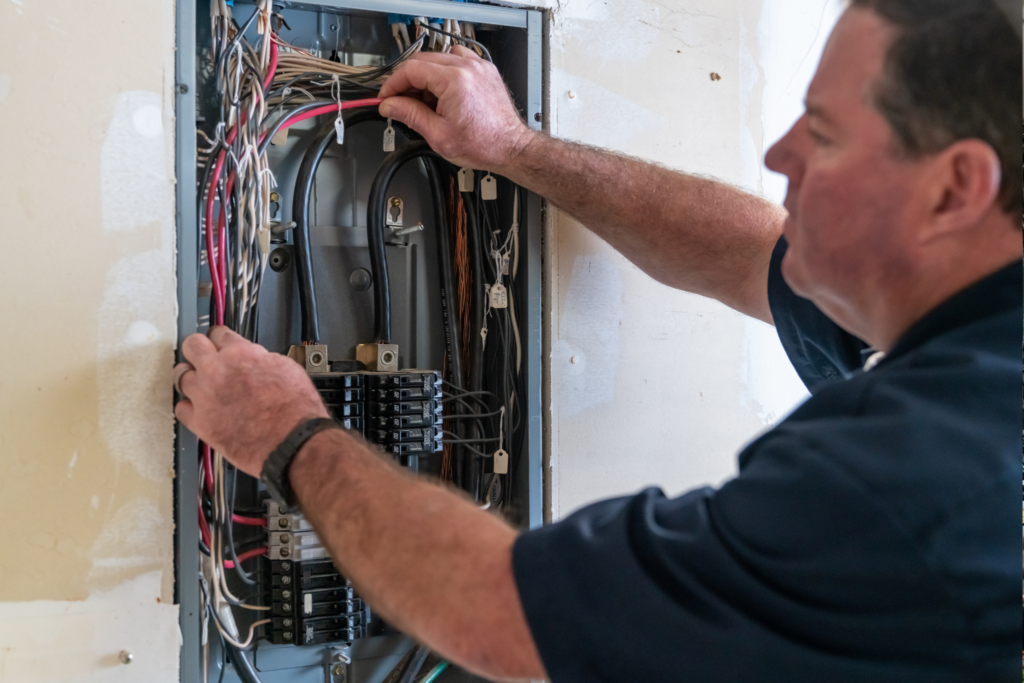
How a Breaker Reads and Stops Dangerous Current
Inside each breaker is a small bimetal strip. When too much current flows through it, the strip heats up and bends. That bend physically trips the switch to OFF or to a middle position. No computer, no sensor. Just metal reacting to heat.
Most homes around Idaho Falls, Pocatello, and Rexburg run a mix of breaker sizes:
- 15-amp: bedrooms, living rooms, most general lighting
- 20-amp: kitchen counters, bathrooms, garages, laundry outlets
- 30-amp and up: HVAC equipment, electric dryers, ranges, water heaters
If a 15-amp bedroom circuit is feeding a space heater, a TV, and a lamp, you are right at the edge. Add a vacuum and the strip bends. The breaker did its job.
The Difference Between a Tripped Breaker and a Failed Breaker
A tripped breaker resets cleanly. You push it fully to OFF, then back to ON, and it stays. Power comes back. A failed breaker behaves differently, and you need to read the signs.
Signs the breaker itself is bad, not the circuit:
- It will not stay in the ON position, even with nothing plugged in
- The breaker feels warm or hot to the touch
- You smell burnt plastic near the panel
- Scorch marks, melting, or discoloration on the breaker face
- The handle feels loose, mushy, or sloppy when you flip it
A hot breaker usually means loose connections or a worn internal contact. That is common in older panels still running across the region, and it is one of the more frequent electrical panel problems Southeast Idaho homeowners deal with in houses built before the 1990s.
One more rule worth knowing. If a breaker trips the instant you reset it, with nothing plugged in, you have an active fault on the wire. That is not a nuisance trip. Stop resetting it and call a licensed electrician.
The 5 Most Common Reasons Your Circuit Breaker Keeps Tripping
After thousands of service calls across Idaho Falls, Pocatello, Rexburg, and Blackfoot, we see the same five culprits over and over. Some are easy fixes. Others are warning signs you should not ignore. Here is how to tell them apart.
Overloaded Circuit
An overloaded circuit is the number one cause we find, especially from November through March. The math is simple. A standard 15-amp, 120-volt circuit handles about 1,800 watts. A 20-amp circuit handles about 2,400 watts. Plug in a 1,500-watt space heater next to a window AC or a hair dryer, and you are already maxed out.
Kitchens are another hot spot. Run the microwave and the coffee maker on the same outlet and the breaker pops. The fix: spread heavy loads across different circuits. If you can’t, you need a dedicated line.
- Space heater: 1,500 watts
- Window AC: 1,200 to 1,500 watts
- Microwave: 1,000 to 1,500 watts
- Coffee maker: 800 to 1,200 watts
Short Circuit
A short circuit happens when the hot wire touches the neutral wire directly. The breaker trips instantly, every time. This is serious.
Watch for these signs of a short circuit in home wiring:
- A popping sound when the breaker trips
- A burning or fishy plastic smell
- Scorch marks around an outlet or switch
- A damaged appliance cord
Do not keep flipping the breaker back on. Each reset sends current into a fault and can start a fire. Unplug everything on that circuit and call a licensed electrician.

Ground Fault
A ground fault is similar to a short, but the current escapes to ground instead of the neutral wire. The most common question we get: what’s the difference between a short circuit and a ground fault? A short is hot-to-neutral. A ground fault is hot-to-ground, often through water, a person, or a metal box.
That’s why a ground fault breaker tripping usually shows up in wet areas: kitchens, bathrooms, garages, basements, and outdoor outlets. Before you blame the panel, check the GFCI outlets on that circuit. Press the test button, then reset. One tripped GFCI can kill power to several outlets downstream.
Weak or Aging Breaker
Yes, a breaker can just wear out. Decades of heat cycling weaken the internal spring and contacts. Eventually it trips at loads it used to handle fine.
We see this constantly in Pocatello and Idaho Falls homes built in the 1970s, 80s, and early 90s, where the original panel is still in service. Tell-tale signs:
- The breaker handle feels loose or wobbly
- The breaker or panel feels warm to the touch
- It trips with light loads, like a single lamp
- You see rust, discoloration, or corrosion inside the panel
If your panel is a Federal Pacific, Zinsco, or original Pushmatic, replacement is not optional — professional panel replacement is the only safe path forward. While you are upgrading, a standby generator with a transfer switch is worth thinking about, given how often winter storms knock out power around here.
Arc Fault
Arc faults are the sneakiest of the circuit breaker tripping causes. Electricity jumps a tiny gap in damaged or loose wiring, often inside a wall. It generates intense heat but may not draw enough current to trip a standard breaker. That is how electrical fires start.
AFCI (Arc Fault Circuit Interrupter) breakers detect these arcs and shut off power before things get hot. The National Electrical Code requires them in bedrooms and most living spaces in newer construction.
So why does your AFCI breaker keep tripping? Usually one of three reasons:
- A damaged cord or appliance is arcing (vacuums and older electronics are frequent offenders)
- A loose connection in an outlet, switch, or junction box
- Damaged wiring inside the wall, sometimes from a nail or screw driven during a remodel
Never bypass an AFCI breaker with a standard one. That breaker is doing its job. If it trips repeatedly with nothing obvious plugged in, the problem is in the wiring itself, and that is a call for our team.
How to Safely Reset a Tripped Breaker (And When Not To)

The Right Way to Reset a Breaker
Follow these steps in order:
- Unplug or switch off the appliance that was running when the trip happened. This prevents an immediate re-trip.
- Open the panel door. Keep your hands on the breaker switches only. Never touch the lugs, bus bars, or any exposed wiring inside.
- Find the tripped breaker. It will sit in the middle position, not fully ON or OFF.
- Push the switch firmly to OFF first. This is the step most homeowners skip, and it’s why the reset fails.
- Then flip it back to ON. You should feel a solid click.
- Close the panel and plug your appliance back in one device at a time.
If the breaker holds, you likely had a simple overloaded circuit. Spread your load across different outlets and you should be fine.
Warning Signs That Mean Stop and Call an Electrician
If the breaker trips again within seconds of resetting it, stop. Do not try a third time. Repeated resets on a short circuit or ground fault can overheat wiring inside the wall and start a fire. That’s not a scare tactic, it’s how electrical fires actually begin.
Stop and call us immediately if you notice any of these red flags:
- The breaker trips instantly the moment you flip it back on
- A burning plastic or fishy smell near the panel or any outlet
- Scorched, discolored, or melted outlets and switch plates
- The breaker itself feels hot to the touch
- Buzzing, humming, or crackling coming from the panel
- The breaker trips with nothing plugged in
- Rust, corrosion, or moisture inside the panel
Any of these point to electrical panel problems that need a licensed electrician, not another reset. Our team handles same-day diagnosis through our electrical panel services, and you can schedule a visit the same day in most cases.
If your breaker trips the moment you reset it, smells like burning plastic, or feels hot to the touch, stop and call us. Our licensed electricians cover the region with same-day availability for electrical faults. Call (208) 744-2675 and we’ll get a tech out to diagnose the panel and fix the problem before it becomes a fire risk.
Frequently Asked Questions
How Much Does It Cost to Replace a Circuit Breaker in Southeast Idaho?
Replacing a single circuit breaker typically costs between $150 and $300 when you factor in parts and labor, though prices vary based on breaker type and panel accessibility. AFCI and GFCI breakers cost more than standard breakers due to their added safety technology. Advanced Home Services can provide an upfront estimate before any work begins so there are no surprises on your bill.
Can a Tripping Breaker Cause a Fire Even If It Keeps Shutting Off?
Yes, a breaker that trips repeatedly can still pose a fire risk, especially if the underlying cause is an arc fault or a deteriorating wire connection. Each time a fault occurs, heat and electrical arcing can damage insulation and surrounding materials before the breaker has time to respond. Never assume that because the breaker keeps cutting power the situation is automatically safe.
Is It Safe to Use a Circuit While Waiting for an Electrician to Arrive?
If the breaker tripped due to a simple overload from too many appliances running at once, you can cautiously reduce the load and use the circuit lightly until your appointment. However, if you noticed burning smells, scorch marks, or heard popping sounds before the trip, avoid using that circuit entirely until a licensed electrician inspects it. Advanced Home Services offers prompt scheduling so you are not left waiting long in an unsafe situation.
How Do I Know If My Electrical Panel Is Too Old to Be Safe?
Most electrical panels have a functional lifespan of 25 to 40 years, and panels older than that may struggle to handle the electrical demands of modern homes. Brands like Federal Pacific and Zinsco have well-documented safety concerns and are worth having evaluated regardless of age. If your Southeast Idaho home still has its original panel from the 1980s or earlier, scheduling an inspection with Advanced Home Services is a smart precaution.
Will Homeowners Insurance Cover Electrical Damage From a Faulty Breaker?
Many standard homeowners insurance policies do cover damage caused by sudden electrical failures, but coverage depends on your specific policy and whether the damage resulted from a known, unaddressed hazard. Insurers can deny claims if they determine the issue was a pre-existing problem you failed to repair. Keeping records of professional inspections and repairs from a licensed electrician like Advanced Home Services can support your claim if damage ever occurs.
Can I Add More Circuits to My Panel Instead of Replacing It?
Adding circuits is possible if your existing panel has open slots and sufficient amperage capacity, which a licensed electrician can confirm with a load calculation. If your panel is already at capacity or undersized for your home, a panel upgrade is typically the safer and more cost-effective long-term solution. Advanced Home Services can assess your current setup and recommend the right path without pushing unnecessary work.
How Long Does a Circuit Breaker Replacement or Panel Inspection Take?
Replacing a single breaker generally takes one to two hours for a licensed electrician, while a full panel inspection typically takes under an hour. A panel upgrade or service change is a larger job that can take four to eight hours depending on the scope of work. Advanced Home Services works efficiently to minimize the time your power is interrupted during any electrical service.
Ready to Get Started with Advanced Home Services?
Tired of resetting the same breaker every other night? Advanced Home Services has been diagnosing tripping breakers, failing panels, and worn wiring across Idaho Falls, Pocatello, Rexburg, and the surrounding valleys for years, and our licensed electricians offer same-day diagnosis in most cases. Call (208) 744-2675 or reach out online before that next trip turns into something worse. Be sure to ask about our current electrical service offers when you call.